
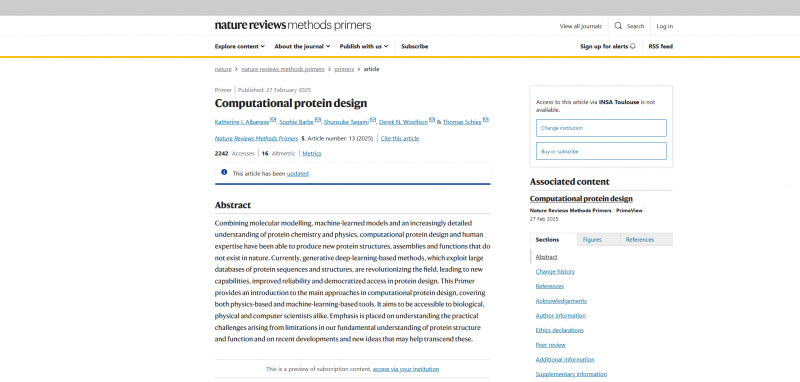
Albanese K.I., Barbe S., Tagami S. et al. (2025). Computational Protein Design. Nature Reviews Methods Primers, DOI : https://doi.org/10.1038/s43586-025-00383-1
Abstract
Combining molecular modelling, machine-learned models and an increasingly detailed understanding of protein chemistry and physics, computational protein design and human expertise have been able to produce new protein structures, assemblies and functions that do not exist in nature. Currently, generative deep-learning-based methods, which exploit large databases of protein sequences and structures, are revolutionizing the field, leading to new capabilities, improved reliability and democratized access in protein design. This Primer provides an introduction to the main approaches in computational protein design, covering both physics-based and machine-learning-based tools. It aims to be accessible to biological, physical and computer scientists alike. Emphasis is placed on understanding the practical challenges arising from limitations in our fundamental understanding of protein structure and function and on recent developments and new ideas that may help transcend these.