
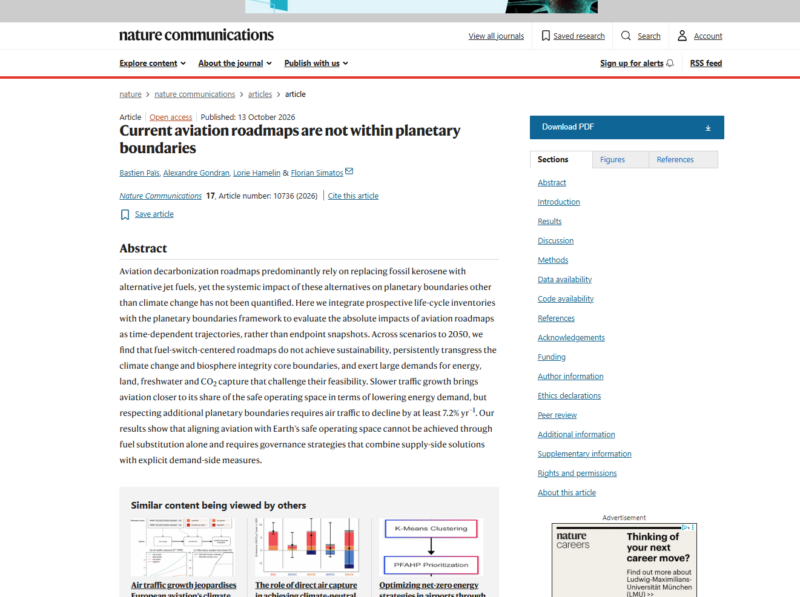
Païs, B., Gondran, A., Hamelin, L. et al. Current aviation roadmaps are not within planetary boundaries. Nat Commun 17, 10736 (2026). https://doi.org/10.1038/s41467-026-77472-6
Abstract
Aviation decarbonization roadmaps predominantly rely on replacing fossil kerosene with alternative jet fuels, yet the systemic impact of these alternatives on planetary boundaries other than climate change has not been quantified. Here we integrate prospective life-cycle inventories with the planetary boundaries framework to evaluate the absolute impacts of aviation roadmaps as time-dependent trajectories, rather than endpoint snapshots. Across scenarios to 2050, we find that fuel-switch-centered roadmaps do not achieve sustainability, persistently transgress the climate change and biosphere integrity core boundaries, and exert large demands for energy, land, freshwater and CO2 capture that challenge their feasibility. Slower traffic growth brings aviation closer to its share of the safe operating space in terms of lowering energy demand, but respecting additional planetary boundaries requires air traffic to decline by at least 7.2% yr−1. Our results show that aligning aviation with Earth’s safe operating space cannot be achieved through fuel substitution alone and requires governance strategies that combine supply-side solutions with explicit demand-side measures.
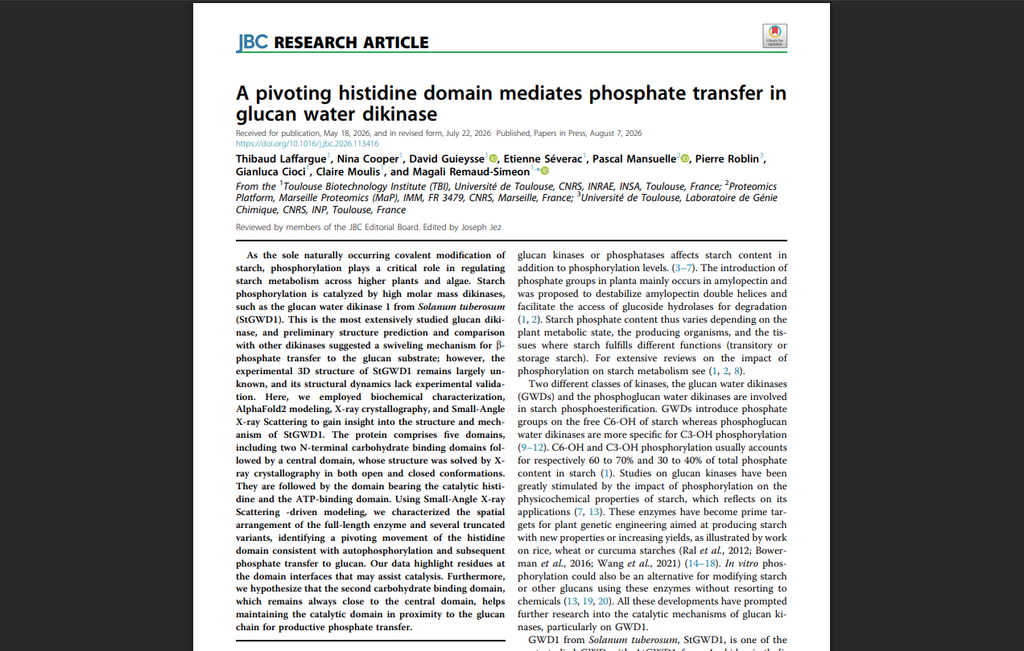
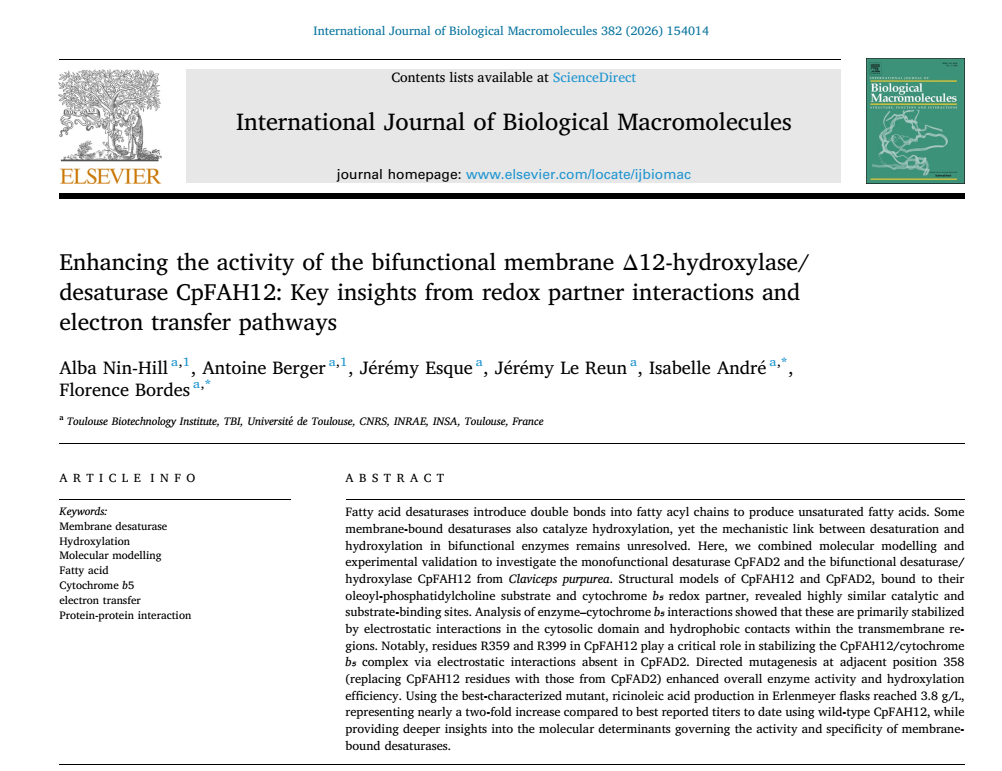
Laffargue T, Cooper N, Guieysse D, Séverac E, Mansuelle P, Roblin P, Cioci G, Moulis C, Remaud-Simeon M. A pivoting histidine domain mediates phosphate transfer in glucan water dikinase. J Biol Chem. 2026 Sep;302(9):113416. doi: 10.1016/j.jbc.2026.113416. Epub 2026 Aug 7. PMID: 42567505; PMCID: PMC13553574. https://pubmed.ncbi.nlm.nih.gov/42567505/
Abstract
As the sole naturally occurring covalent modification of starch, phosphorylation plays a critical role in regulating starch metabolism across higher plants and algae. Starch phosphorylation is catalyzed by high molar mass dikinases, such as the glucan water dikinase 1 from Solanum tuberosum (StGWD1). This is the most extensively studied glucan dikinase, and preliminary structure prediction and comparison with other dikinases suggested a swiveling mechanism for β-phosphate transfer to the glucan substrate; however, the experimental 3D structure of StGWD1 remains largely unknown, and its structural dynamics lack experimental validation. Here, we employed biochemical characterization, AlphaFold2 modeling, X-ray crystallography, and Small-Angle X-ray Scattering to gain insight into the structure and mechanism of StGWD1. The protein comprises five domains, including two N-terminal carbohydrate binding domains followed by a central domain, whose structure was solved by X-ray crystallography in both open and closed conformations. They are followed by the domain bearing the catalytic histidine and the ATP-binding domain. Using Small-Angle X-ray Scattering -driven modeling, we characterized the spatial arrangement of the full-length enzyme and several truncated variants, identifying a pivoting movement of the histidine domain consistent with autophosphorylation and subsequent phosphate transfer to glucan. Our data highlight residues at the domain interfaces that may assist catalysis. Furthermore, we hypothesize that the second carbohydrate binding domain, which remains always close to the central domain, helps maintaining the catalytic domain in proximity to the glucan chain for productive phosphate transfer.
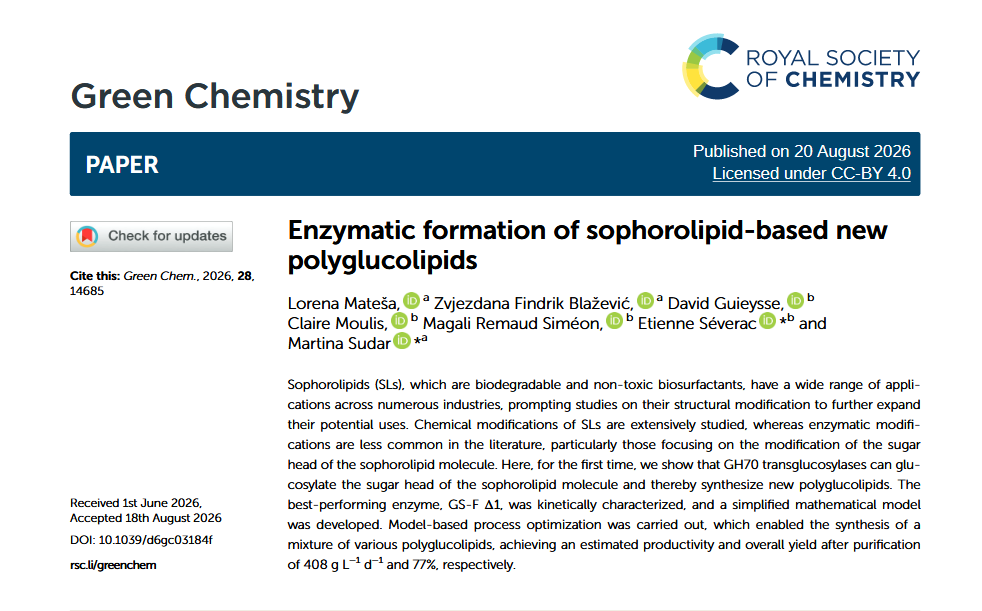
Lorena Mateša, Zvjezdana Findrik Blažević, David Guieysse, Claire Moulis, Magali Remaud Siméon, Etienne Séverac, Martina Sudar; Enzymatic formation of sophorolipid-based new polyglucolipids. Green Chem. 2026; 28 (36): 14685–14697. https://doi.org/10.1039/d6gc03184f
Abstract
Sophorolipids (SLs), which are biodegradable and non-toxic biosurfactants, have a wide range of applications across numerous industries, prompting studies on their structural modification to further expand their potential uses. Chemical modifications of SLs are extensively studied, whereas enzymatic modifications are less common in the literature, particularly those focusing on the modification of the sugar head of the sophorolipid molecule. Here, for the first time, we show that GH70 transglucosylases can glucosylate the sugar head of the sophorolipid molecule and thereby synthesize new polyglucolipids. The best-performing enzyme, GS-F Δ1, was kinetically characterized, and a simplified mathematical model was developed. Model-based process optimization was carried out, which enabled the synthesis of a mixture of various polyglucolipids, achieving an estimated productivity and overall yield after purification of 408 g L−1 d−1 and 77%, respectively.
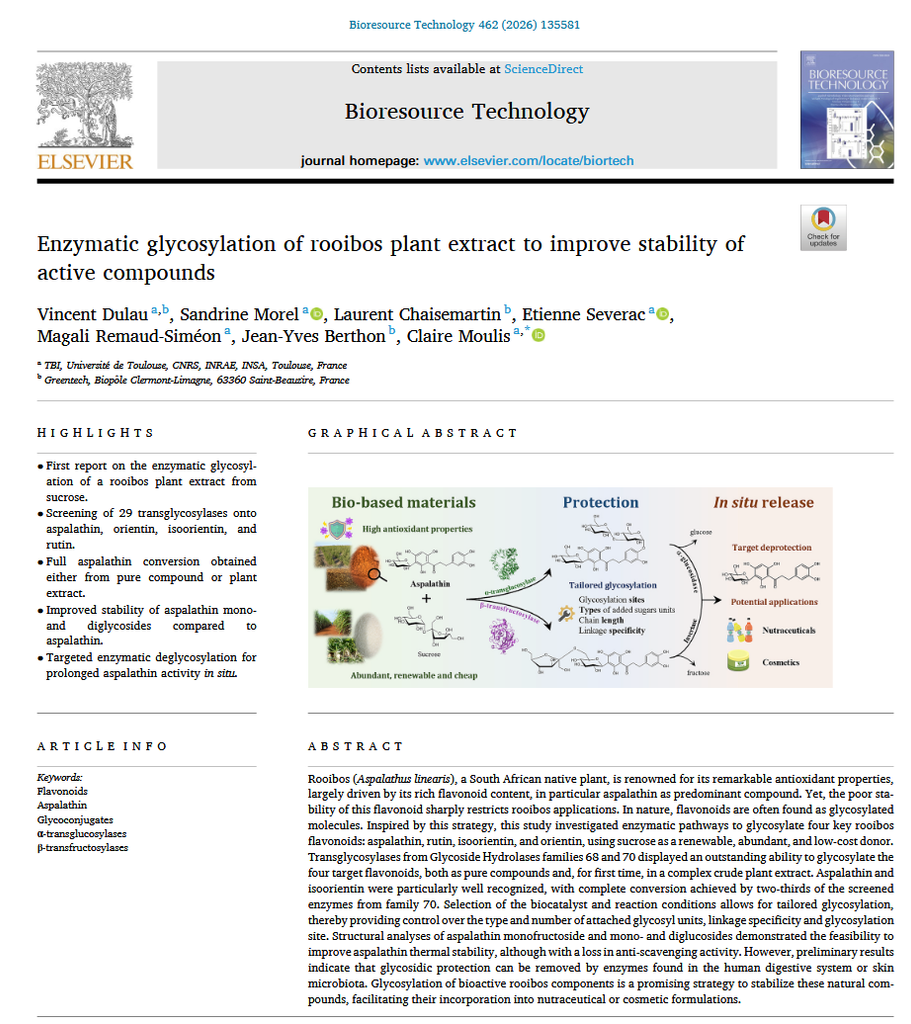
Vincent Dulau, Sandrine Morel, Laurent Chaisemartin, Etienne Severac, Magali Remaud-Siméon, Jean-Yves Berthon, Claire Moulis,
Enzymatic glycosylation of rooibos plant extract to improve stability of active compounds,
Bioresource Technology,
Volume 462,
2026,
135581,
ISSN 0960-8524,
https://doi.org/10.1016/j.biortech.2026.135581.
(https://www.sciencedirect.com/science/article/pii/S0960852426016639)
Abstract:
Rooibos (Aspalathus linearis), a South African native plant, is renowned for its remarkable antioxidant properties, largely driven by its rich flavonoid content, in particular aspalathin as predominant compound. Yet, the poor stability of this flavonoid sharply restricts rooibos applications. In nature, flavonoids are often found as glycosylated molecules. Inspired by this strategy, this study investigated enzymatic pathways to glycosylate four key rooibos flavonoids: aspalathin, rutin, isoorientin, and orientin, using sucrose as a renewable, abundant, and low-cost donor. Transglycosylases from Glycoside Hydrolases families 68 and 70 displayed an outstanding ability to glycosylate the four target flavonoids, both as pure compounds and, for first time, in a complex crude plant extract. Aspalathin and isoorientin were particularly well recognized, with complete conversion achieved by two-thirds of the screened enzymes from family 70. Selection of the biocatalyst and reaction conditions allows for tailored glycosylation, thereby providing control over the type and number of attached glycosyl units, linkage specificity and glycosylation site. Structural analyses of aspalathin monofructoside and mono- and diglucosides demonstrated the feasibility to improve aspalathin thermal stability, although with a loss in anti-scavenging activity. However, preliminary results indicate that glycosidic protection can be removed by enzymes found in the human digestive system or skin microbiota. Glycosylation of bioactive rooibos components is a promising strategy to stabilize these natural compounds, facilitating their incorporation into nutraceutical or cosmetic formulations.
Keywords: Flavonoids; Aspalathin; Glycoconjugates; α-transglucosylases; β-transfructosylases