5 – 7 octobre 2026
Séminaire de CNRS Ingénierie à TBI
Jeudi, 8 octobre⋅-11:00 – Amphi Vinci
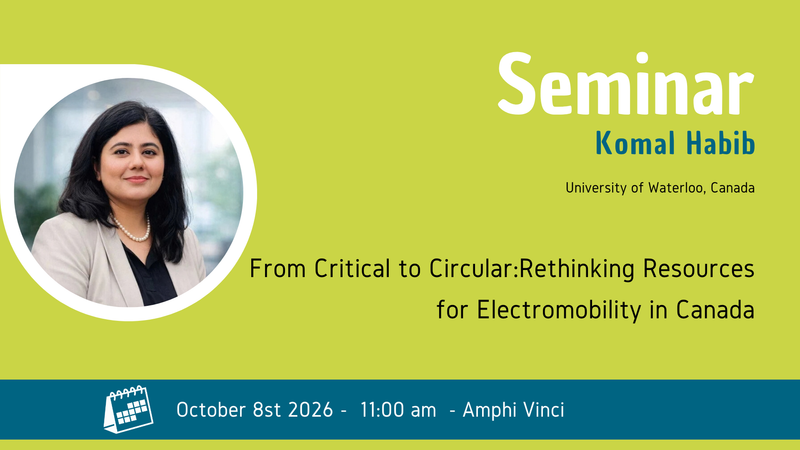
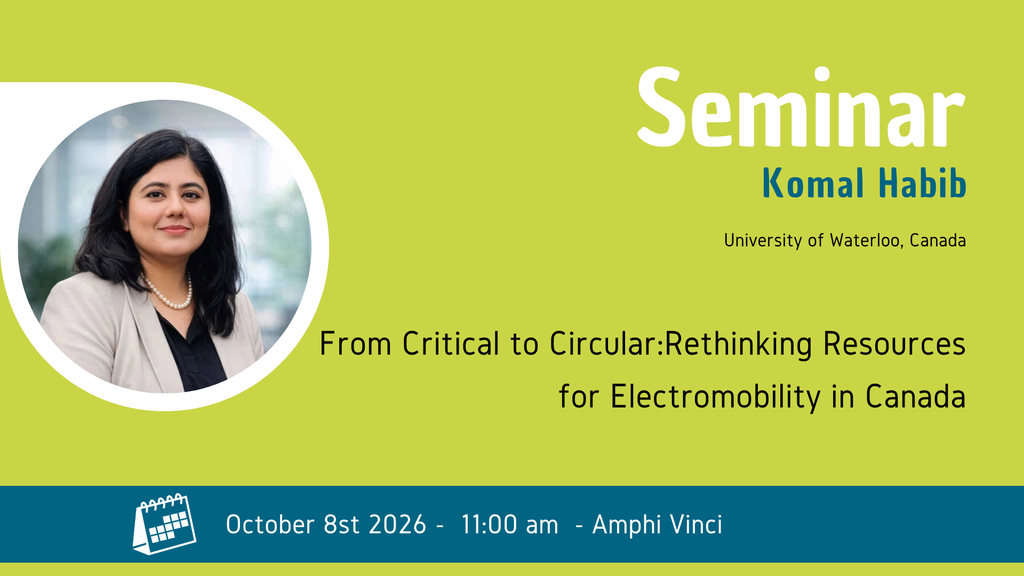
Séminaire de Komal Habib
University of Waterloo, Canada
From Critical to Circular:Rethinking Resources for Electromobility in Canada
Dr. KomalHabib is an associate professor of industrial ecology at the Faculty ofEnvironment, University of Waterloo in Canada. Her research program specializesin resource criticality assessment for a future powered by clean energysystems. Dr. Habib’s work brings together approaches from criticalityassessment, material flow analysis, life-cycle thinking, and circular economyto investigate the availability, demand, use, and recovery of criticalmaterials across current and emerging technology systems. Her researchcontributes to understanding how resource constraints and material dependenciescan influence the sustainability and resilience of low-carbon transitions.
In her talk she will present herongoing work related to critical materials and their circularity. This lecturewill explore the critical materials underpinning the Canadian transition toelectromobility, examining the material demands and resource challengesassociated with electric vehicles and their supporting infrastructure.
Mardi, 13 octobre⋅-11:00 – Amphi Sophie Germain
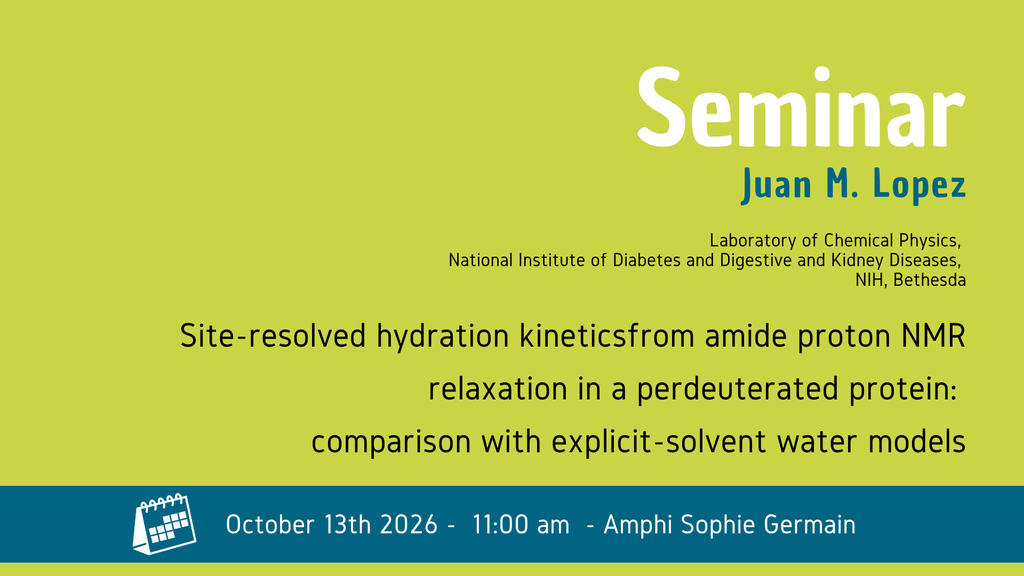
Séminaire de Juan M. Lopez
Laboratory of Chemical Physics, NationalInstitute of Diabetes and Digestive and Kidney Diseases, NIH, Bethesda
Site-resolved hydration kineticsfrom amide proton NMR relaxation in a perdeuterated protein: comparison with explicit-solvent water models
The hydration layer plays a keyrole in protein structure, stability, and function, and commonly extends beyondthe first coordination sphere. Here, detailed site-resolved kinetics of theinteraction between water hydrogens and amide protons in a perdeuteratedprotein are extracted from ¹H relaxation analysis. By combining fivelongitudinal and four rotating-frame relaxation experiments at three magneticfields, which sample different spectral-density components, we decompose themultiple dipolar and CSA contributions that govern amide proton relaxation.This approach enables direct extraction of hydration dynamics, revealing waterresidence lifetimes in the first solvation shell spanning ~10–1000 ps. The dataprovide clear experimental evidence that long-range dipolar interactions withbulk solvent contribute significantly to both longitudinal and transverserelaxation, even at buried sites, as previously described by Halle. However, atsites with prolonged hydration lifetimes, cross-relaxation is dominated by asmall number of long-lived water molecules, highlighting pronounced spatialheterogeneity in protein hydration. These results were further compared withcrystallographic waters observed in X-ray structures. Comparison with moleculardynamics simulations using four widely employed force fields shows thatff99SBws yields the closest agreement with experiment, whereas the other modelsdisplay systematic deviations. Together, these results establish amide ¹Hrelaxation as a powerful, site-specific probe of hydration dynamics and providea stringent experimental benchmark for validating explicit-solvent molecularsimulations. These results also provide a comprehensive picture of 1HNrelaxation in perdeuterated proteins and help resolve the apparent paradox ofwhy amide protons relax much faster experimentally than predicted by simplifiedsimulations that consider only the ¹Hᴺ–¹⁵N dipolar interaction.