Gleeza Manulat, Florence Garcia-Launay, Caroline Sablayrolles, Lorie Hamelin,
From residual biomass to novel feed ingredients for pigs, broilers and fish: A methodology for integrating feed formulation and consequential life cycle assessment,
Cleaner and Circular Bioeconomy,
Volume 15,
2026,
100221,
ISSN 2772-8013,
https://doi.org/10.1016/j.clcb.2026.100221.
https://www.sciencedirect.com/science/article/pii/S2772801326000187
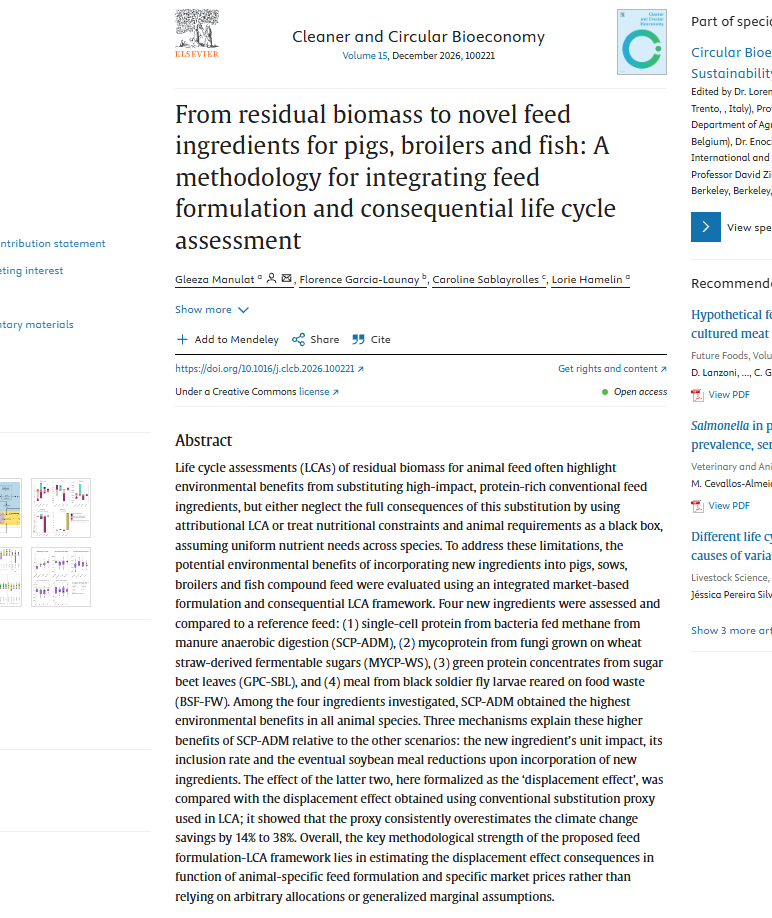
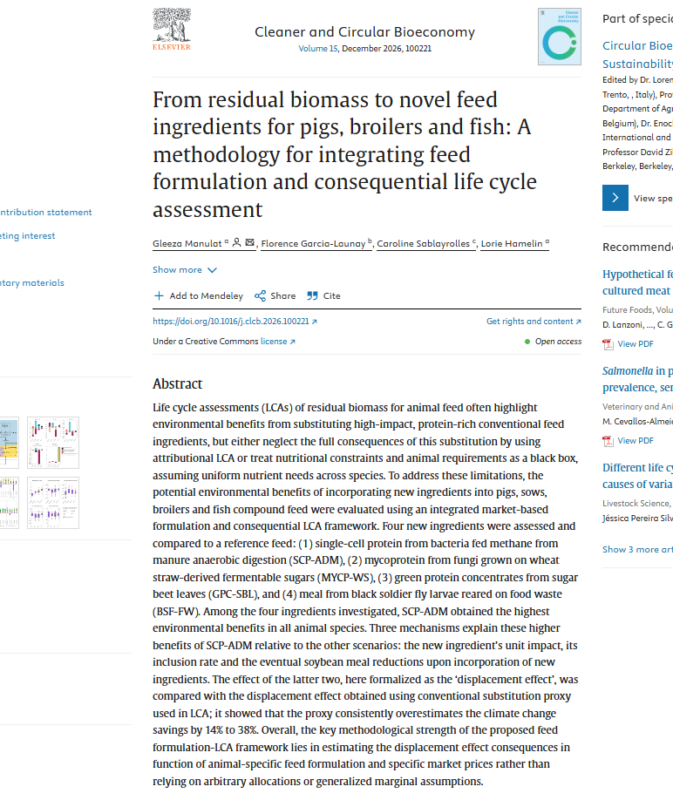
Abstract: Life cycle assessments (LCAs) of residual biomass for animal feed often highlight environmental benefits from substituting high-impact, protein-rich conventional feed ingredients, but either neglect the full consequences of this substitution by using attributional LCA or treat nutritional constraints and animal requirements as a black box, assuming uniform nutrient needs across species. To address these limitations, the potential environmental benefits of incorporating new ingredients into pigs, sows, broilers and fish compound feed were evaluated using an integrated market-based formulation and consequential LCA framework. Four new ingredients were assessed and compared to a reference feed: (1) single-cell protein from bacteria fed methane from manure anaerobic digestion (SCP-ADM), (2) mycoprotein from fungi grown on wheat straw-derived fermentable sugars (MYCP-WS), (3) green protein concentrates from sugar beet leaves (GPC-SBL), and (4) meal from black soldier fly larvae reared on food waste (BSF-FW). Among the four ingredients investigated, SCP-ADM obtained the highest environmental benefits in all animal species. Three mechanisms explain these higher benefits of SCP-ADM relative to the other scenarios: the new ingredient’s unit impact, its inclusion rate and the eventual soybean meal reductions upon incorporation of new ingredients. The effect of the latter two, here formalized as the ‘displacement effect’, was compared with the displacement effect obtained using conventional substitution proxy used in LCA; it showed that the proxy consistently overestimates the climate change savings by 14% to 38%. Overall, the key methodological strength of the proposed feed formulation-LCA framework lies in estimating the displacement effect consequences in function of animal-specific feed formulation and specific market prices rather than relying on arbitrary allocations or generalized marginal assumptions.
Keywords: Alternative feed; Bio- circular economy; Black soldier fly; Green protein concentrate; Mycoprotein; Single cell protein