Vendredi, 6 mars⋅-10:15 à 11:15
Séminaire TBI, Guilherme José Maximo, invité L. Hamelin
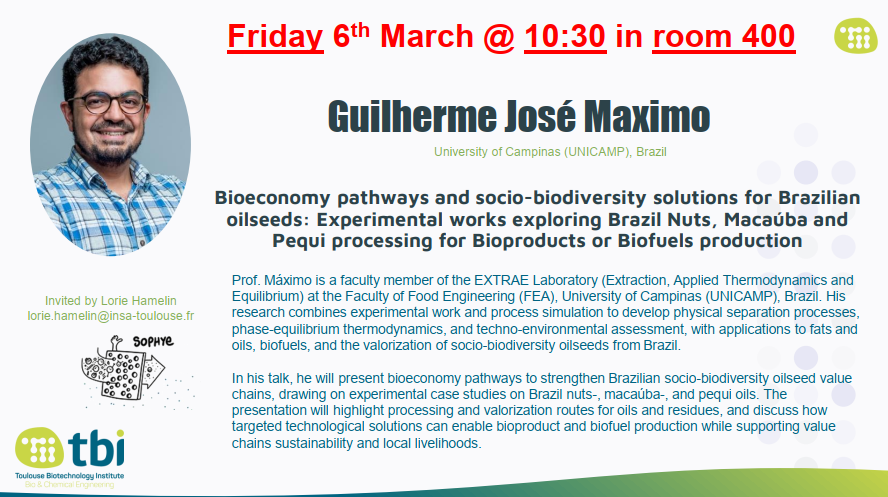
Guilherme José Maximo
Title: Bioeconomy pathways and socio-biodiversity solutions for Brazilian oilseeds: Experimental works exploring Brazil Nuts, Macaúba and Pequi processing for Bioproducts or Biofuels production
Prof. Máximo is a faculty member of the EXTRAE Laboratory (Extraction, Applied Thermodynamics and Equilibrium) at the Faculty of Food Engineering (FEA), University of Campinas (UNICAMP), Brazil. His research combines experimental work and process simulation to develop physical separation processes, phase-equilibrium thermodynamics, and techno-environmental assessment, with applications to fats and oils, biofuels, and the valorization of socio-biodiversity oilseeds from Brazil.
In his talk, he will present bioeconomy pathways to strengthen Brazilian socio-biodiversity oilseed value chains, drawing on experimental case studies on Brazil nuts-, macaúba-, and pequi oils. The presentation will highlight processing and valorization routes for oils and residues, and discuss how targeted technological solutions can enable bioproduct and biofuel production while supporting value chains sustainability and local livelihoods.
Vendredi, 6 mars⋅– 13:00
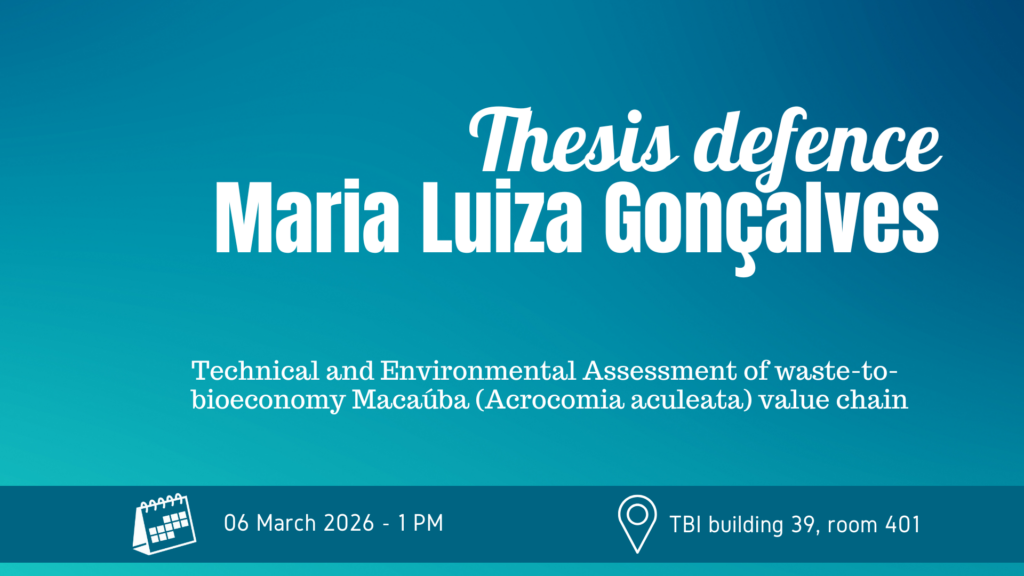
PhD defense – Maria Luiza Gonçalves
Abstract:
The cultivation of Macaúba (Acrocomia aculeata), a native species of the Atlantic Forest, has emerged in Brazil as a sustainable alternative to recover degraded land. Its fruit oils are extracted from the kernel and pulp. The kernel oil is of high quality and is intended for the food and cosmetic markets, whereas the pulp oil typically has high acidity, leading many producers to discard it as waste. Therefore, producers face the challenge of optimizing the efficient utilization of this co-product, here referred to as crude Macaúba pulp oil (MCPO), the core object of this PhD thesis. A foreseen promising alternative in Brazil is its use in biodiesel production. In fact, the National Biofuels Policy (RENOVABIO) establishes the gradual substitution of diesel with biodiesel, with a target of 15% by 2030, in addition to providing financial incentives to biofuel producers. In alignment with this policy, current legislation (Law No. 14.993) encourages investments in the production and use of renewable fuels for terrestrial transport (biodiesel), aviation (biokerosene), and energy generation (biogas, direct heat and power). This PhD thesis first analyzed, both through experimental and simulation work, the technical feasibility of producing ethyl biodiesel from MCPO, more specifically under the enzymatic catalysis route rather than the well-established chemical catalytic route. To this end, it considered applying liquid low-cost commercial enzymes from Aspergilus oryzae with ethanol, assumed to be less polluting than traditional routes using methanol and alkaline catalysis. Second, this work assessed, through consequential Life Cycle Assessment (LCA), the environmental implications of MCPO competing uses within the broader context of the bioeconomy, including soap production, biodiesel, biokerosene for aviation and refined food-grade oil.
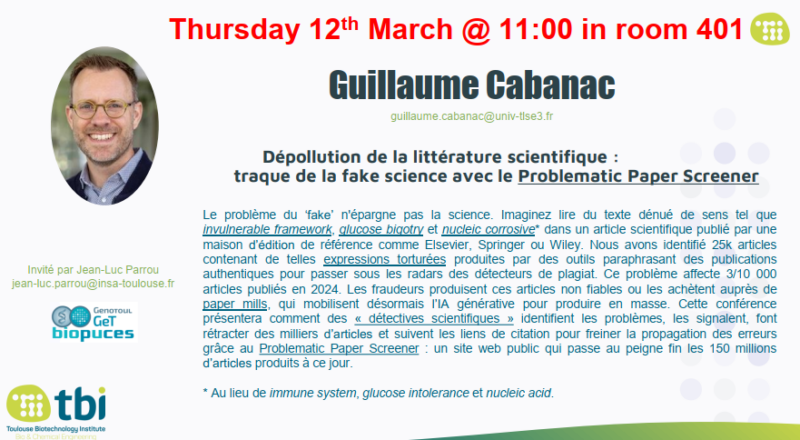
Jeudi, 12 mars⋅-11:00 à 12:00
Séminaire Guillaume Cabanac
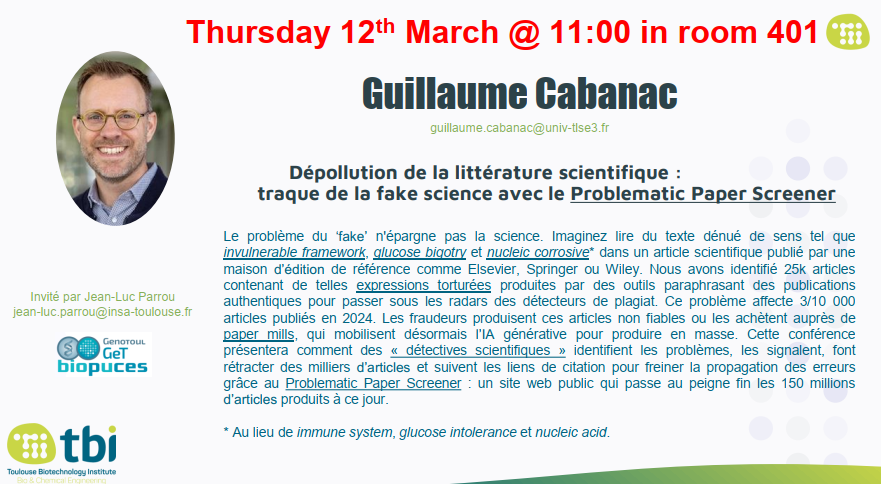
Dépollution de la littérature scientifique : traque de la fake science avec le Problematic Paper Screener
— résumé —
Le problème du ‘fake’ n’épargne pas la science. Imaginez lire du texte dénué de sens tel que invulnerable framework, glucose bigotry et nucleic corrosive* dans un article scientifique publié par une maison d’édition de référence comme Elsevier, Springer ou Wiley. Nous avons identifié 25k articles contenant de telles expressions torturées produites par des outils paraphrasant des publications authentiques pour passer sous les radars des détecteurs de plagiat. Ce problème affecte 3/10 000 articles publiés en 2024. Les fraudeurs produisent ces articles non fiables ou les achètent auprès de paper mills, qui mobilisent désormais l’IA générative pour produire en masse. Cette conférence présentera comment des « détectives scientifiques » identifient les problèmes, les signalent, font rétracter des milliers d’articles et suivent les liens de citation pour freiner la propagation des erreurs grâce au Problematic Paper Screener : un site web public qui passe au peigne fin les 150 millions d’articles produits à ce jour.
* Au lieu de immune system, glucose intolerance et nucleic acid.
— biographie —
Guillaume Cabanac est professeur d’informatique à l’Université de Toulouse et membre de l’Institut de recherche en informatique de Toulouse (IRIT UMR 5505 CNRS). Il est titulaire d’une chaire de recherche fondamentale de l’Institut universitaire de France (IUF) intitulée « dépollution de la littérature scientifique ». Ses travaux visent à identifier des publications non fiables par fouille de textes, notamment au sein du projet ERC Synergy ‘Nanobubbles’ questionnant le processus d’auto-correction de la science. Il développe le ‘Problematic Paper Screener’ qui traque des publications non fiables, pourtant publiées et souvent vendues par les maisons d’édition de premier plan. Au quotidien, ses signalements d’articles problématiques, contenant notamment des expressions torturées, ont donné lieu à plus de 3 500 rétractations. Sa recherche a été distinguée dans le palmarès “Nature’s 10” présentant « dix personnes qui ont contribué à façonner la science en 2021 » selon la revue Nature.
> Plus d’infos : coupures de presse et documentaires.