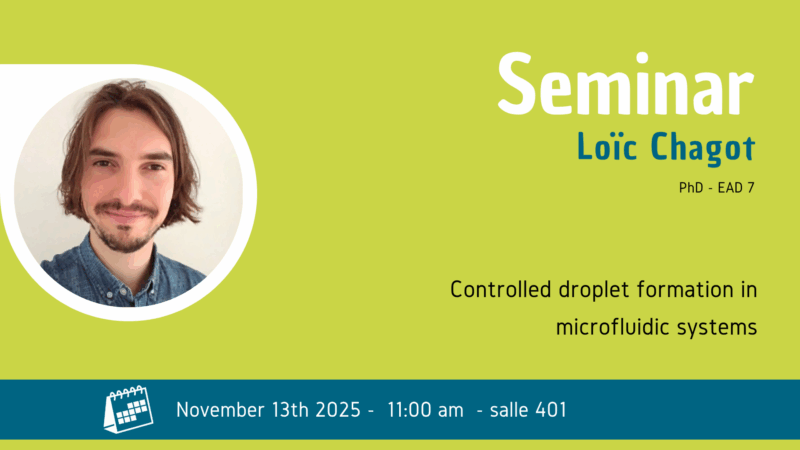
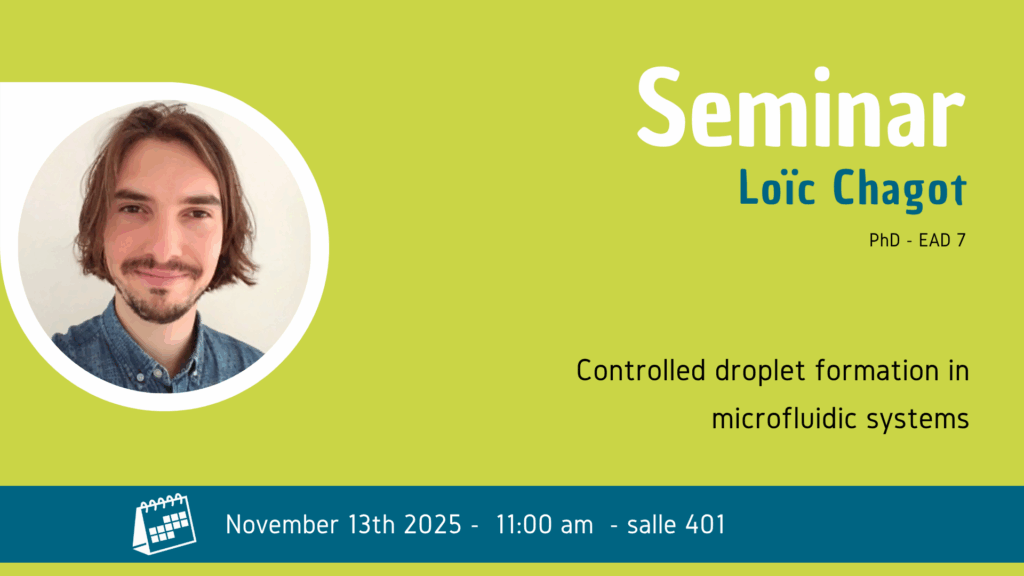
Jeudi, 13 novembre⋅– 11:00 salle 401
TBI seminar / L. Chagot EAD7
Controlled droplet formation in microfluidic systems
Abstract: Microfluidic technologies offer efficient tools to study physicochemical and biophysical phenomena by producing controlled droplets. Regulating droplet formation is crucial for applications ranging from inkjet printing to drug delivery. In microchannels, droplet generation typically proceeds through three main stages: expansion, necking and pinch-off. Understanding these dynamics is essential to tune droplet size and frequency precisely. Interfacial properties strongly influence this process, and the use of surfactants or colloidal particles allows modification of the droplet behaviour. Such control enables the design of stable and reproducible emulsions tailored to specific applications. This seminar will discuss the mechanisms of droplet formation, the role of interfacial effects, and strategies to achieve precise control in microfluidic systems.
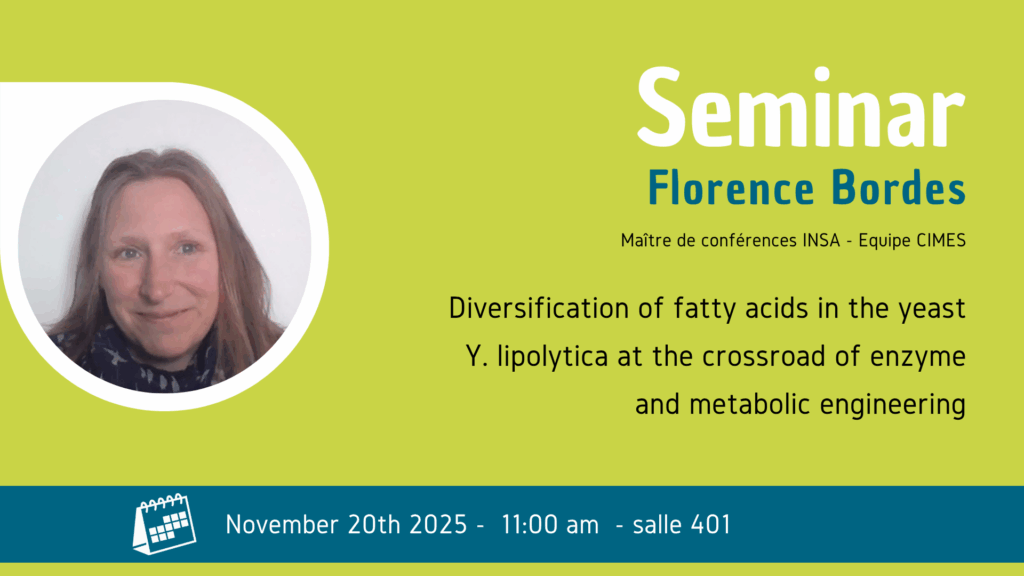
Jeudi, 20 novembre⋅– 11:00
Séminaire de Florence Bordes EAD1
Diversification of fatty acids in the yeast Y. lipolytica at the crossroad of enzyme and metabolic engineering
Yarrowia lipolytica, a non-conventional oleaginous yeast, has become an attractive host for many biotechnological applications, particularly in the field of lipids and lipid-derived products. By combining enzyme and metabolic engineering strategies, we have developed different evolved enzymes and strains to expand the range of products that can be synthesised by this yeast.
This talk will describe our strategies for investigating the molecular determinants of enzyme specificity in the synthesis and modification of fatty acids. It will also present the genetic tools (CRISPR-Cas9 system and mini-artificial chromosome) that we have developed in recent years to facilitate the engineering of this yeast.
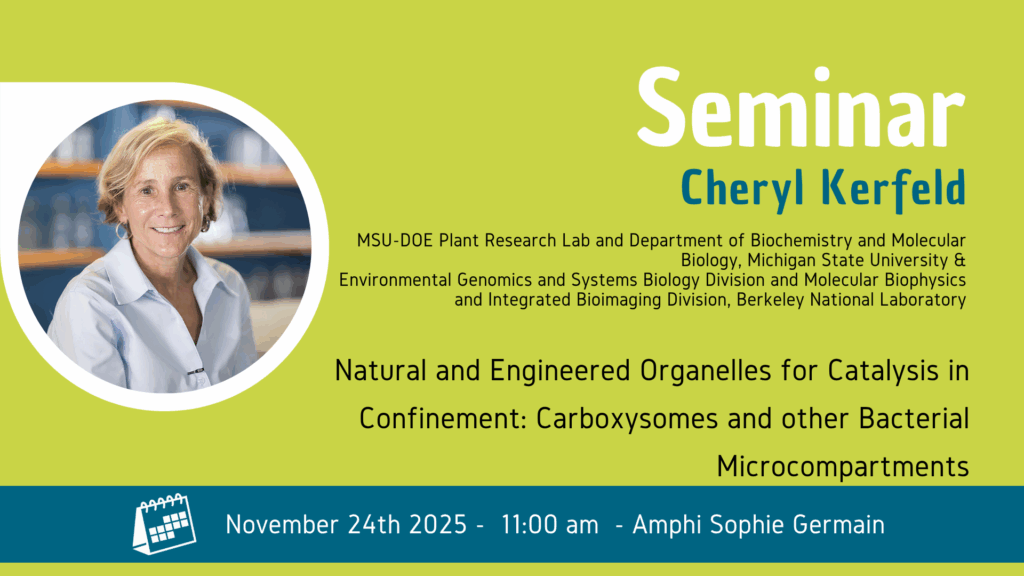
Lundi, 24 novembre – 11h00 – Amphi Sophie Germain INSA
Invited speaker C. Kerfeld
MSU-DOE Plant Research Lab and Department of Biochemistry and Molecular Biology, Michigan State University and
Environmental Genomics and Systems Biology Division and Molecular Biophysics and Integrated Bioimaging Division, Berkeley National Laboratory
Titre: Natural and Engineered Organelles for Catalysis in Confinement: Carboxysomes and other Bacterial Microcompartments
Abstract:
Bacterialmicrocompartments (BMCs) represent biological modularity asmultienzyme-containing proteinaceous organelles. Bioinformatic analyses haverevealed the widespread occurrence of BMCs across the Bacterial Kingdom. The generalized structure of BMCs establishes catalyst proximity and spatial controlof local reactant and substrate concentrations, sequesters volatile or reactiveintermediates, and controls metabolite and gas exchange with the surroundingenvironment. Accordingly, BMCs can beviewed as a biological paradigm for spatially confined chemistry. In addition to fundamental studies of the structureand function of BMCs, recent advances in programming and assembling BMCs invivo and in vitro poise this biological architecture to become a platform forthe study spatially confined chemistry. BMC architectures provide a templatefor combining synthetic chemistry with synthetic biology to resolve mechanismsfor spatial control of reaction networks with unprecedented precision. Relativeto lipid-bound compartments, the protein-based boundary of the BMC can beprecisely structurally defined and the multiple shell constituents can beindividually tuned for electron, substrate, product, and potentially gastransport properties. Knowledge of howBMCs self-assemble, circumscribe a private co-factor pool, and how theyvariously confine radicals, volatiles, and toxic intermediates poises thisbiological architecture to become a platform for exploring the mechanisticproperties of catalysis in spatially organized, multi-scale, hierarchical host confinement.
Jeudi, 4 décembre⋅– 11:00
TBI Seminar / H. Kulyk, pole Techno
Vendredi, 12 décembre⋅– 11:00
Séminaire TBI / Invité / F. Bellvert
Vendredi, 19 décembre
entre 08h30 et 10h30
🎄 Petit déjeuner de Noël