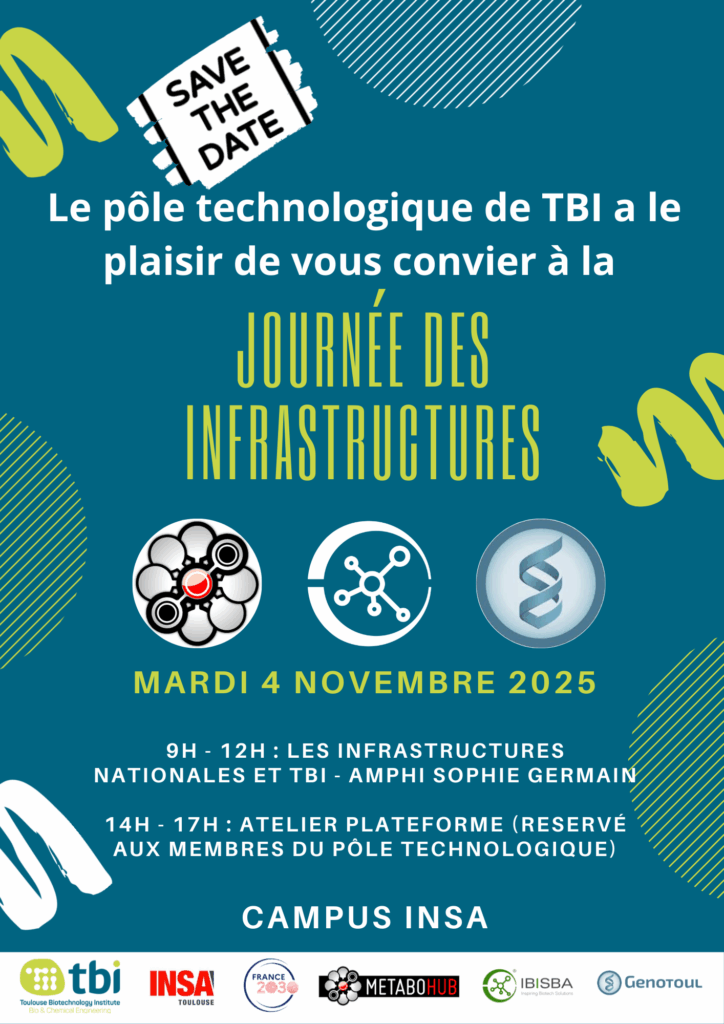
Mardi, 4 novembre – 09:00 à 17:00
Journée du pole techno
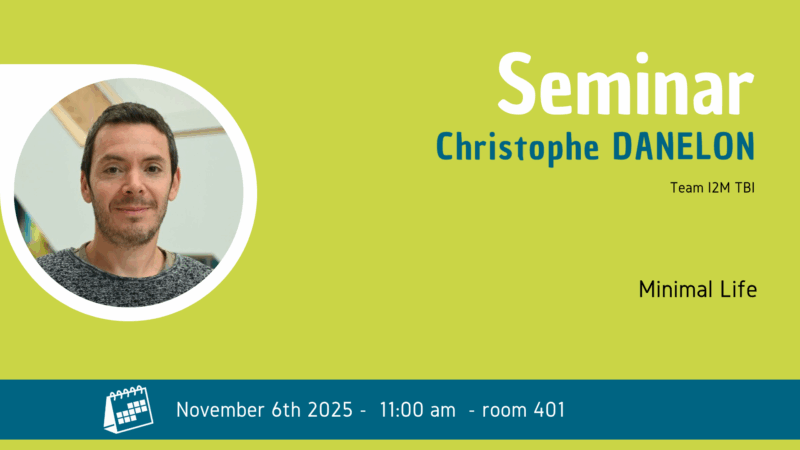
Jeudi, 6 novembre – 11:00
Sémianire Christophe Danelon
What are the minimalrequirements to support life? How can we re-create life in the laboratory usingevolutionary processes? Our research group is building basic cellularfunctions, and eventually a fully autonomous cell, using a bottom-up syntheticbiology approach. I will present our latest results on synthetic genomeassembly, replication, phospholipid biosynthesis, and membrane constriction. Wewill see how integrating continuous evolution, smart microscopy, activelearning and lab automation can accelerate the development of synthetic cells.The remaining challenges and opportunities that may arise from the emergingsynthetic cell technologies will be briefly discussed.

Jeudi, 13 novembre⋅-11:00
Séminaire M. Castelain EAD7
Jeudi, 20 novembre⋅– 11:00
Séminaire F. Bordes EAD1
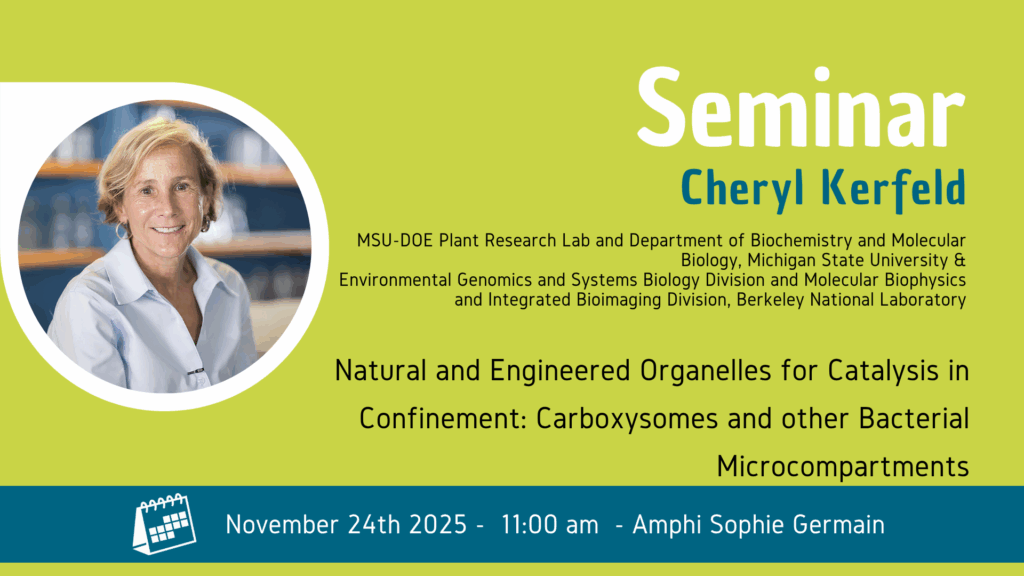
Lundi, 24 novembre – 11h00 – Amphi Sophie Germain INSA
Invited speaker C. Kerfeld
MSU-DOE Plant Research Lab and Department of Biochemistry and Molecular Biology, Michigan State University and
Environmental Genomics and Systems Biology Division and Molecular Biophysics and Integrated Bioimaging Division, Berkeley National Laboratory
Titre: Natural and Engineered Organelles for Catalysis in Confinement: Carboxysomes and other Bacterial Microcompartments
Abstract:
Bacterialmicrocompartments (BMCs) represent biological modularity asmultienzyme-containing proteinaceous organelles. Bioinformatic analyses haverevealed the widespread occurrence of BMCs across the Bacterial Kingdom. The generalized structure of BMCs establishes catalyst proximity and spatial controlof local reactant and substrate concentrations, sequesters volatile or reactiveintermediates, and controls metabolite and gas exchange with the surroundingenvironment. Accordingly, BMCs can beviewed as a biological paradigm for spatially confined chemistry. In addition to fundamental studies of the structureand function of BMCs, recent advances in programming and assembling BMCs invivo and in vitro poise this biological architecture to become a platform forthe study spatially confined chemistry. BMC architectures provide a templatefor combining synthetic chemistry with synthetic biology to resolve mechanismsfor spatial control of reaction networks with unprecedented precision. Relativeto lipid-bound compartments, the protein-based boundary of the BMC can beprecisely structurally defined and the multiple shell constituents can beindividually tuned for electron, substrate, product, and potentially gastransport properties. Knowledge of howBMCs self-assemble, circumscribe a private co-factor pool, and how theyvariously confine radicals, volatiles, and toxic intermediates poises thisbiological architecture to become a platform for exploring the mechanisticproperties of catalysis in spatially organized, multi-scale, hierarchical host confinement.