
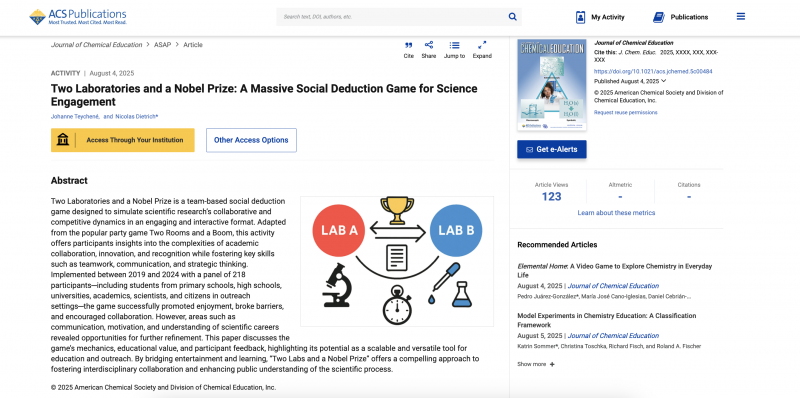
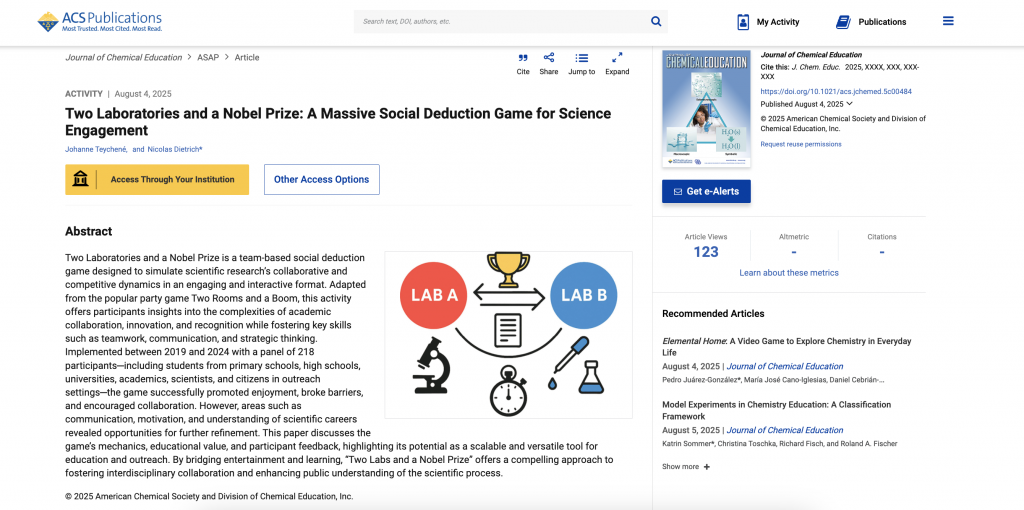
Two Laboratories and a Nobel Prize: A Massive Social Deduction Game for Science EngagementJohanne Teychené and Nicolas DietrichJournal of Chemical Education Article ASAP DOI: 10.1021/acs.jchemed.5c00484
Abstract: Two Laboratories and a Nobel Prize is a team-based social deduction game designed to simulate scientific research’s collaborative and competitive dynamics in an engaging and interactive format. Adapted from the popular party game Two Rooms and a Boom, this activity offers participants insights into the complexities of academic collaboration, innovation, and recognition while fostering key skills such as teamwork, communication, and strategic thinking. Implemented between 2019 and 2024 with a panel of 218 participants─including students from primary schools, high schools, universities, academics, scientists, and citizens in outreach settings─the game successfully promoted enjoyment, broke barriers, and encouraged collaboration. However, areas such as communication, motivation, and understanding of scientific careers revealed opportunities for further refinement. This paper discusses the game’s mechanics, educational value, and participant feedback, highlighting its potential as a scalable and versatile tool for education and outreach. By bridging entertainment and learning, “Two Labs and a Nobel Prize” offers a compelling approach to fostering interdisciplinary collaboration and enhancing public understanding of the scientific process.
Christhel Andrade Díaz, Ezequiel Zamora-Ledezma, Lorie Hamelin,
A spatial dataset on Ecuadorian cropping systems and theoretical crop residue potentials,
Data in Brief,
Volume 62,
2025,
111910,
ISSN 2352-3409,
https://doi.org/10.1016/j.dib.2025.111910.
(https://www.sciencedirect.com/science/article/pii/S2352340925006341)
Abstract: This dataset provides a high-resolution, spatially explicit baseline of Ecuadorian cropping systems and associated pedoclimatic conditions to support long-term modeling of soil organic carbon (SOC) dynamics and biomass resource planning. The dataset is built from national sources, including Ecuadorian agricultural statistics and crop production surveys spanning 2002 – 2019. Ten dominant crops, representing over 90 % of the country’s cultivated area, are characterized across 23,021 Agricultural Pedoclimatic Units (APCUs), each defined by unique combinations of soil attributes, climate variables, and crop types. For each APCU, the dataset includes theoretical harvestable crop residue potentials, above- and belowground carbon inputs, and SOC-relevant parameters such as root depth distribution and biomass composition. Residue-to-product ratios (RPR), root-to-shoot biomass ratios (R:S), and biomass-to-carbon conversion coefficients were compiled through a comprehensive literature review and transparently documented. Additionally, the dataset includes monthly projections of average temperature, cumulative precipitation, and estimated evapotranspiration from 2020 to 2070 under the RCP4.5 climate scenario. Temperature and precipitation data were obtained from downscaled daily projections based on an ensemble of global climate models, and evapotranspiration was subsequently calculated using the Thornthwaite method. All variables were spatially assigned to each APCU. This open-access dataset is designed for reuse in soil carbon modeling frameworks, supports the design of biomass mobilization strategies, and informs climate-smart land-use strategies in tropical agricultural systems.
Keywords: Cropping systems; Crop residues; Spatial data; Soil organic carbon; Biomass potential; Tropical agriculture; Pedoclimatic units