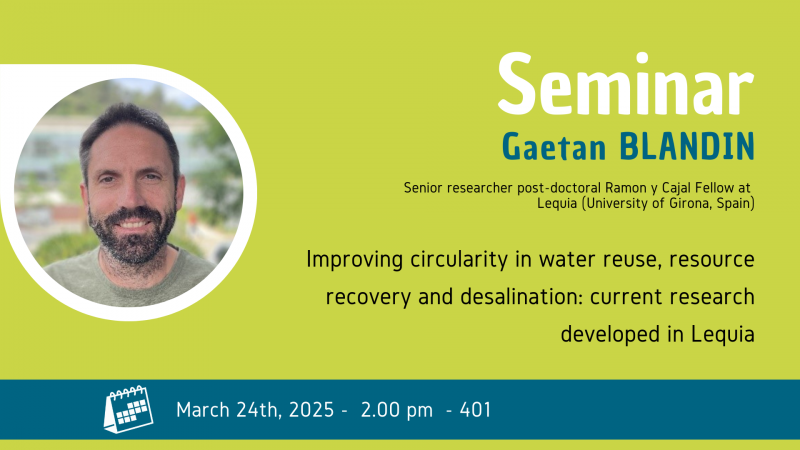
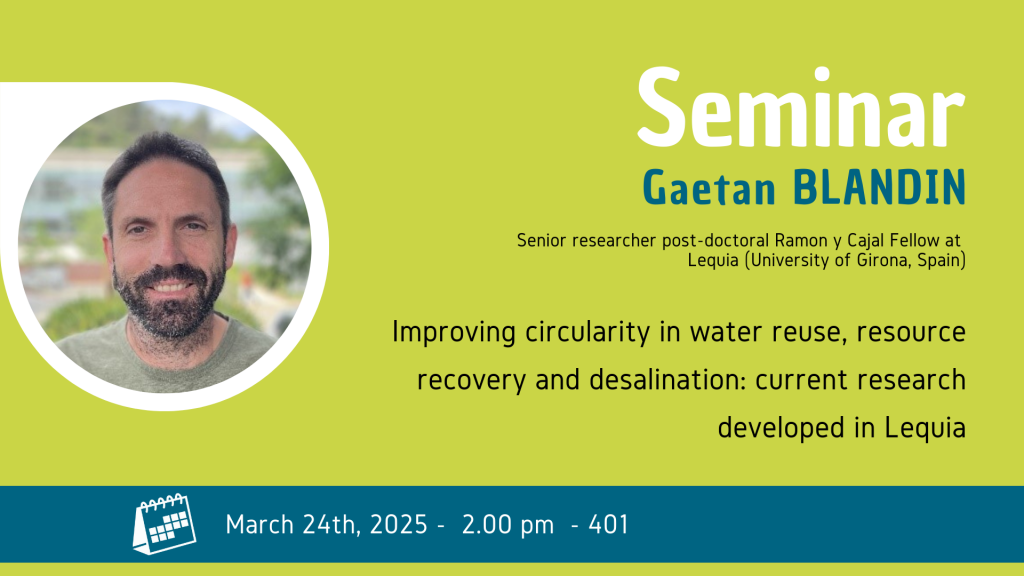
Lundi, 24 mars⋅– 14:00 – salle 401
Séminaire TBI / Gaetan BLANDIN
Improving circularity in water reuse, resource recovery and desalination: current research developed in Lequia
Seawater desalination and water reuse are nowadays state of the art technologies for alternative water sources where reverse osmosis (RO) desalination process play a main role as a barrier to salts and most contaminants. While energy continues to be a limitation for broader desalination plants implementations, assuring safe water reuse and public acceptance is a remaining concern for water reuse development. Apart from recovering and producing water of the highest quality, moving towards circularity also includes reducing energy consumption, making use of nutrients recovery as well as considering membrane reuse. Those approaches are considered through 3 projects developed in Lequia: Forward Factory, ConcentrA and Osmo4Lives. Forward Factory aims at reducing energy costs in desalination down to 1kWh.m-3 while allowing for 90% water recovery from wastewater using Forward Osmosis (FO) as central technology. Additionally, sides benefits could be obtained through the concentration of nutrients from the wastewater (organic matter, N, P) to facilitate their downstream recovery and transformation into valuable resources. ConcentrA projects aims at separating and concentrating volatile fatty acids from fermentation of agrifood industry wastewater streams to facilitate downstream bioplastics (PHA) production. Finally, Osmo4Lives objectives are to recycle end of life reverse osmosis (RO) membranes to give then 4 additional lives and to validate recycled membranes in various applications.
Jeudi, 27 mars⋅– 13:00
Séminaire TBI / Alain Marty
End of life of plastics: from enzyme and process optimizationto industrial reality
Plasticsare found everywhere in our daily life due to exceptional properties. Theworldwide market reaches 460 million tons. However, they represent a majorenvironmental issue with 125 million tons of generated plastic waste annually.Only 10% of collected plastics are recycled, and, at best, plastic wastes areincinerated but an unacceptable quantity are lost in nature, with 9 milliontons ending each year in the oceans.
Carbios (http://www.carbios.com), a young innovative green chemistrycompany, developed an enzymatic process to recycle one of the main plastics,PET (~100 million tons per year). A first breakthrough was reached with theoptimization of an extraordinary PETase used to break down PET returning tomonomers1. Since then, we continue to optimizethis enzyme, to improve kinetics and yields and the performances of our bestenzymes will be presented. The scale-up of the process in an industrialdemonstrator will be presented with a 20m3reactor and all the downstream processing to purify both terephthalic acid andethylene glycol. The conference will focus on the new results concerningtextiles, which account for 70% of the PET market.
Fewwords will be given to present an enzymatic solution to make PLA biodegradablein home compost2.
References:
- 1. Tournier et al., Nature; 580,7802, 9 April 2020
- 2. Guicherd et al., Nature; 631, 884, 17 July2024
Keywords: PETrecycling, enzyme, PETase, PLA biodegradation