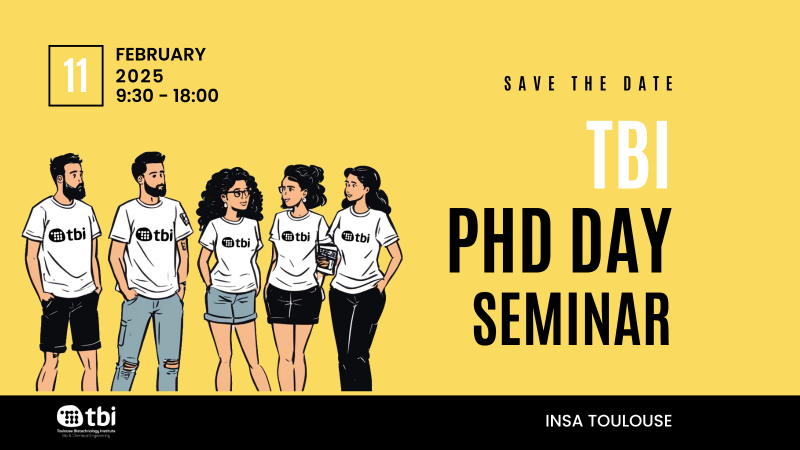
Mardi, 11 février⋅09:00
🎓 PhD Day
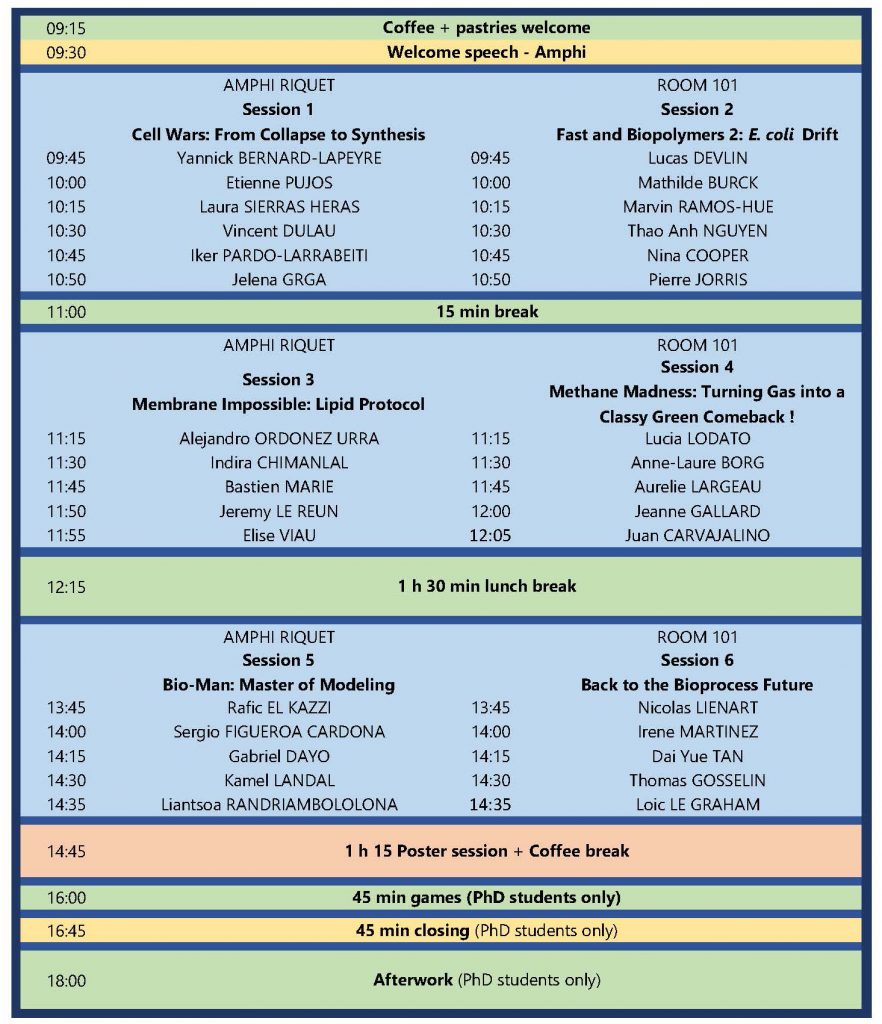
We would like to share with you the updated and definitive schedule for PhDay 2025, which is taking place next week on Tuesday 11th. You can find the schedule in the PDF attached to this email.
We also kindly remind you the deadline for the 1st-year posters is tomorrow February 4th (we have received 5/16 posters for now) and the abstracts and presentations for 2nd- and 3rd-years is Friday, February 7th. Thank you to those that have already sent us their posters/abstracts/slides.
In the evening, we will meet at the Dubliners pub in Saint-Michel, located at 46 Av. Marcel Langer, 31400 Toulouse, around 18h00. Pizzas will also be ordered, offered by TBI! 🍕 Please let us know if you plan on joining, so that we can estimate the number of people and pizzas. You can use the following link to access the Doodle:
https://doodle.com/meeting/participate/id/dRkVKPVe
Jeudi, 13 février⋅13:00
Séminaire Bin Yang
Professor in the Department of Biological Systems Engineering at WSU Pullman and the Bioproducts, Sciences & Engineering –
Laboratory at WSU Tri-Cities
Recipient of the Fullbright-De Toqueville Chair 2025 at INSA/TBI
Innovating Towards a Sustainable Bioeconomy Future
An important current focus of research in biology, chemistry, engineering, agriculture, and environmental sciences is the development of clean technologies that utilize cellulosic biomass as a renewable resource to the largest extent possible in a biorefinery setting to produce sustainable liquid transportation fuels, chemicals and materials. Of all sustainable resources, only biomass can be transformed into organic fuels, chemicals, and materials that can integrate well into our current
infrastructure with the inherent convenience, cost, and efficiency advantages. Cellulosic biomass can be converted to biofuels and bioproducts through aqueous-phase processes involving carbohydrates-derived and lignin-derived reactive intermediates deconstructed from these structural components within biomass. Conversion of all major biopolymers within biomass, including lignin in addition to
cellulose and hemicellulose, offers promising opportunities for enhancing the overall operational efficiency, carbon conversion yield, economic viability, and sustainability of biorefinery. Despite the potential, the conversion of lignin to biofuels has proven to be challenging. In this talk, an overview of state-of-the-art technologies for advanced biofuels production as well as Prof. Yang’s recent research and development on both catalytic and biological pathways to upgrade lignin to jet fuel, chemicals, and materials will be discussed.